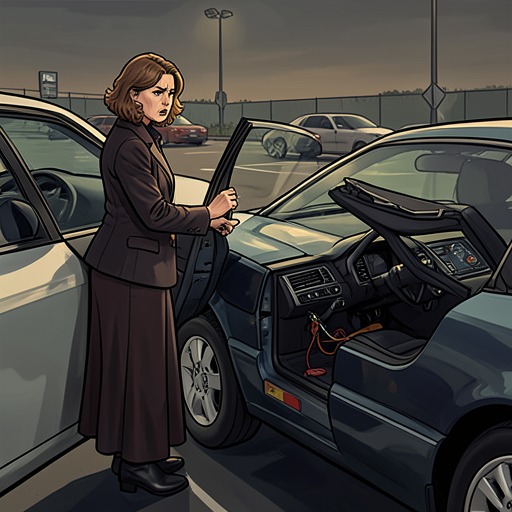
Sofia’s first time driving her mother home
Hot MilkSofia’s first time driving her mother home transforms an urgent practical problem into a small but consequential reversal in their caregiving relationship. Rose hands over the keys when she says she cannot drive after drinking anise liqueur; Sofia insists she cannot drive at all. The trip that follows is neither a clean triumph nor a formal lesson. It is a negotiated act of trust, full of corrections, a crushed doll, and Rose’s running commentary, ending with her announcement that she has a new chauffeur.
The handover of the keys
Rose does not wait for Sofia to feel ready. She throws the keys into her daughter’s lap and tells her to drive them home. Sofia’s first response is an emphatic refusal: she cannot drive. Rose counters that she can, adding that the anise liqueur was too strong and she cannot drive either. The immediate reason for the handover is therefore practical, but the scene also exposes a larger arrangement: Rose needs help, and Sofia is the person expected to provide it.
Rose begins moving her body into the passenger seat, leaving Sofia little room to keep refusing. Sofia has to get out, walk around to the driver’s side, sit down, put the key in the ignition, and start the engine. Her first movement is a reverse. Rose calls it perfect, but the approval arrives before the maneuver’s consequence: something crunches beneath the wheels. Rose looks out and identifies it as a child’s doll. Rather than stopping the lesson, she directs Sofia to change gear, use the indicator, put on her seat belt, and continue. The crushed toy registers the cost of learning in this improvised setting, even as Rose keeps the car moving.
Learning under instruction
Sofia begins at ten miles an hour. Rose leans forward to adjust the mirror and tells her to go faster. The new motorway is empty, and Sofia gradually corrects the gear stick and dares to increase her speed. Rose says she feels completely safe, but immediately adds a correction: in Spain, they drive on the right-hand side. Sofia laughs. Rose then coaches her through an uphill stretch, a gear change, and an approaching overtaking car, correcting Sofia when she calls the driver “him” by pointing out that the driver is a woman.
The exchange makes Rose both passenger and instructor. Sofia is at the wheel, but Rose supplies the knowledge that helps her interpret the road: where to look, when to change gear, and how to read another driver’s position. The lesson is not a simple transfer of control from mother to daughter. Rose remains actively involved, shaping Sofia’s decisions from the seat beside her. Sofia’s confidence grows through that guidance; she reflects that driving is a breeze after working the coffee machines, just as Rose said it would be.
The car still resists an easy ending. Something rolls around in the boot, banging against the sides whenever Sofia turns. She slows down, and the car jerks to a stop. Rose tells her to find a better balance between the brake and accelerator and to put the car into neutral before starting again. When Sofia misjudges the gear, Rose adjusts it for her. Her practical help is affectionate, but it also reveals the limits of Sofia’s new competence: she can take the wheel without yet mastering every part of driving.
Mutual dependence
Rose identifies another risk: Sofia has no licence, but Rose says her lack of spectacles worries her more. She will have to be Sofia’s eyes. Sofia then gives the scene its concise account of their interdependence: “She is my eyes. I am her legs.” The sentence belongs to the drive’s circumstances—Rose watches and directs from the passenger seat while Sofia operates the car—but it also recalls the broader language of care between them.
Earlier, Sofia described her life as being defined by her preoccupation with her mother, Rose. She explained that they had come to Spain to visit the Gómez Clinic and discover what was wrong with Rose’s legs. Elsewhere, Sofia describes Rose as her creditor and herself as repaying her mother with her legs, always running around for her. Those details give the driving lesson an economic and bodily context: caring for Rose is not a metaphorical attachment alone, but work that has shaped Sofia’s time, movement, and sense of obligation. Here the direction of assistance briefly becomes more visible in the opposite way. Sofia supplies the physical act of driving; Rose lends her judgment and vision.
That reciprocity does not erase the imbalance in their relationship. Sofia has taken time away from work for Rose and has agreed to sit in on treatment at the clinic, finding that she pays for freedom by listening to her mother’s words. The drive offers no declaration that the caregiving burden has ended. Instead, the two manage a specific need together, each contributing a different capacity. The car becomes a space where dependence is admitted through action: Rose needs a driver, while Sofia needs Rose’s instructions.
Arrival and a new role
After they reach the car park at the end of the village, Sofia pulls up the handbrake. Rose announces that she has a new chauffeur. The line turns the uncertain first drive into a newly recognized role, although it does not establish that Sofia has obtained a licence or become an experienced driver. What changes is Rose’s confidence in naming her daughter as someone who can take the wheel—and Sofia’s experience of having done so.
The moment’s intimacy remains mixed with friction and family history. Rose touches the oiled curls at the nape of Sofia’s neck and compares her hair to that of the taxi driver who got Rose and Christos lost on their honeymoon in Kefalonia. The gesture brings the driving scene back into the family’s past without making the present a simple reconciliation. Sofia describes her love for her mother as something that cuts deeply. In this episode, that depth is expressed through a mundane, risky task: a daughter drives, a mother instructs, and both arrive at the car park with their familiar dependence briefly rearranged.